Spanner Shopping: What Actually Earns Its Place in a Big-Bike Garage
There's a particular kind of man who owns four torque wrenches and no socket that fits his own rear axle nut. You'll find him in any UK owners' forum at 11pm, asking whether a 32mm will 'do' for a 33mm fastener. The answer, incidentally, is no — and if you've ever seen a rounded axle nut on a bike that weighs as much as a small piano, you'll know why it matters.
Building a home kit for a heavy-duty motorcycle is a different exercise from outfitting a shed for a 125. The fasteners are bigger, the torque figures are higher, and the consequences of getting it wrong are considerably more spectacular. Here's what earns its keep.
Start With Torque, Not Tools
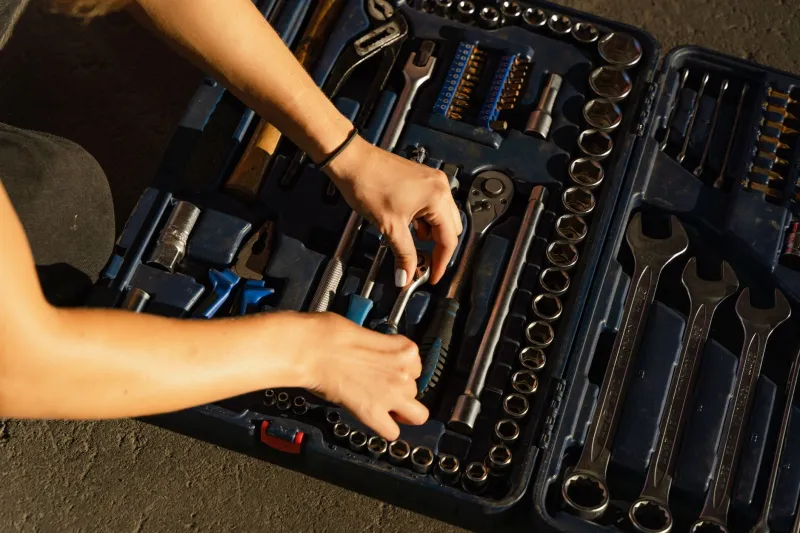
Before you buy anything, buy the manual. Whether that's a Haynes, an official workshop PDF, or the torque table from an owners' club, you need real numbers. A 1/2-inch torque wrench covering roughly 40-200Nm will handle most big-bike work — axle nuts, caliper bolts, engine mounts. Add a 1/4-inch drive wrench for the small stuff where 10Nm is a lot, and a 3/8-inch for the middle ground if you're feeling flush.
Expect to pay £70-£140 for something trustworthy from Sealey, Draper or Halfords Advanced. Do not buy the cheapest one on a marketplace site and assume it's calibrated. Torque wrenches drift, especially if you store them wound up rather than backed off to zero — which is, of course, exactly what everyone does.
The Non-Negotiables
- Breaker bar, 600mm. Nothing else will shift a rear axle nut that's been through a British winter.
- Six-point sockets, not twelve. More contact area means less chance of rounding something expensive.
- Deep sockets, because big tourers love recessed nuts behind pannier frames.
- Hex and Torx socket sets in 3/8-inch drive. Modern fairings and engine cases are held together almost entirely with T25, T30 and T40 fasteners these days.
- A decent oil drain pan with a lip and a spout. A 300kg bike with a 5-litre sump and a low fairing will find a way to empty oil everywhere except the pan.
- Filter wrench or cup, matched to your filter size. There is no universal fit, whatever the packaging claims.
- A tyre pressure gauge you trust, plus a compressor. A 300kg bike running two-up with luggage is far more sensitive to a 4psi shortfall than a naked.
- Head torch. Non-negotiable. You will always be working under something that blocks the garage light.
The Odd Sizes Big Bikes Demand
This is where the money goes. A typical large tourer or adventure bike will ask for a 32mm or 36mm rear axle socket, a 22mm or 24mm front axle, an 8mm hex for a front spindle on some models, and a 14mm hex for others. Buy them individually rather than a giant set — a single quality 32mm 6-point impact socket costs £12-£18 and will outlive you.
If your bike has a single-sided swingarm, you'll need the specific hub socket. If it has shaft drive, add a proper grease gun and the right spline grease. If it's chain-driven, budget for a riveting tool — cheap kits work, but a decent chain breaker and riveter is about £50-£80 and takes the guesswork out of a job that will strand you if it goes wrong.
A 1/2-inch impact driver, corded or battery, transforms seized fastener work. It's also the first thing I'd suggest sharing with a neighbour rather than buying outright.
Lifting and Holding
A 300kg motorcycle cannot be held on a side stand while you lever at a rear axle. You need a plan.
- Paddock stand with hook bobbins — £60-£100. Fine if the bike has mounting points.
- Centre stand plus a front-end lift — many tourers come with a centre stand, and a simple scissor jack under the sump guard (with a wooden spreader plate) handles the front.
- A proper abba-style stand or frame-mounted lift is the gold standard at £150-£200 and worth it if you're doing your own tyre changes.
- A hydraulic bench or scissor lift is lovely if you've got the ceiling height. Most of us haven't.
Whatever you choose, add a pair of ratchet straps and a chock. Redundancy is cheap.
Where to Spend, Where to Borrow
Spend on: torque wrenches, sockets that touch axle nuts, brake bleeding kit, your lifting solution, and anything with a seal that keeps oil inside the engine. These are the tools you'll use repeatedly and curse if they fail.
Borrow or farm out: compression testers, bearing pullers, valve spring tools, tyre fitting equipment, laser alignment gauges, and diagnostic interfaces. If you own a BMW, the GS-911 style diagnostic tool is genuinely useful, but at several hundred pounds it's a group purchase or a loan from a club member. Brake bleeder syringes are cheap enough to buy, but a vacuum bleeder is a borrow.
A Job Saved by One Socket
A regular in the workshop had a big shaft-drive tourer with a rear hub nut that had clearly been tightened by someone with an impact gun and a grudge. He'd already tried a twelve-point socket from a mixed set, which had neatly cambered every flat on the nut. The bike was immovable, and the local dealer had quoted a four-figure sum to cut it off.
The fix was a £16 single-hex impact socket in the correct size, a breaker bar with a length of scaffold tube over it, and about forty minutes of patience with penetrating fluid. One socket. That's the whole story. It's also why the odd sizes are worth buying properly and individually.
Keeping It All in a Single Garage
A 300kg bike eats floor space, so vertical thinking matters. Socket rails on the wall, a magnetic strip for spanners, a rolling tool chest that tucks under a workbench, and clear lidded boxes for the consumables — threadlock, copper grease, nitrile gloves, cable ties, an assortment of M6 and M8 bolts and trim clips. A pegboard behind the bench costs £30 and saves an hour a month in rummaging.
Keep fluids on a drip tray, keep the manual in a plastic wallet, and keep a notebook of torque figures and part numbers for your specific machine. In five years, that notebook will be worth more than half the tools in the box.