Concrete, Clearance and a Good Chock: Making a Small UK Garage Work for a Big Motorcycle
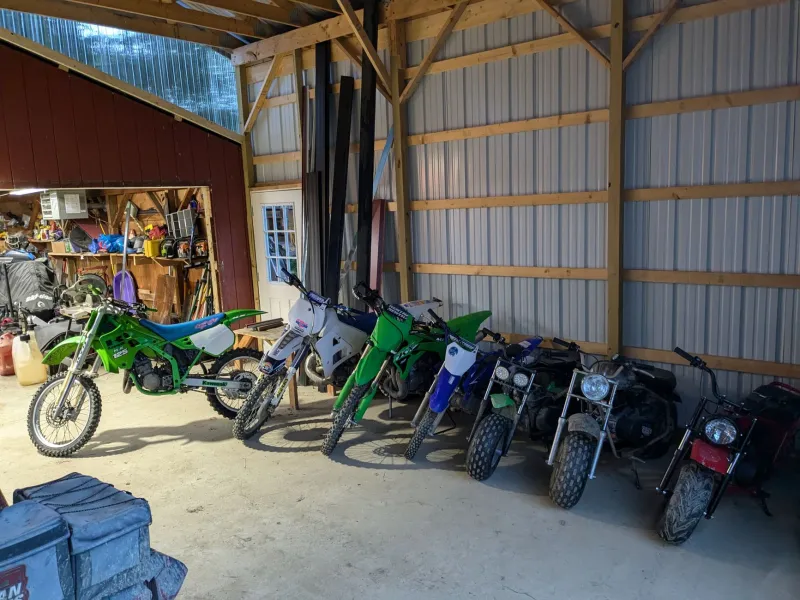
There is a particular moment of doubt that arrives when you push a quarter-tonne tourer towards a typical British single garage. The door looks narrower than it did yesterday. The shelves seem to have crept inwards. The bike itself appears to have grown panniers, mirrors and a top box since you last parked it. None of this means the garage is unsuitable. It means the garage needs a plan.
A 300kg motorcycle does not demand a palatial workshop. It demands a space that respects weight, clearance and the fact that you will one day be tired, cold and trying to park it in the dark. Treat the garage as a small workshop that happens to store a motorcycle, not a showroom that occasionally hosts a spanner, and most UK sheds and single garages can be made to work.
Start With the Floor, Not the Tool Wall
The floor is the first thing to audit. A modern concrete garage slab will usually take a heavy tourer without complaint, but the bike does not spread its weight evenly. Most of it goes through the front and rear contact patches, and a good deal more goes through the side stand, centre stand or paddock stand. That is a point load, not a gentle average.
If the garage floor is cracked, hollow-sounding or laid over old block paving with voids beneath, sort that out before you drill anything. A timber shed floor is a different matter. A 300kg bike plus rider kit, tools and a workbench is a lot to ask of ordinary shed joists. If the floor flexes when you walk on it, do not park the bike on it. Use the shed for gear and find a concrete base for the motorcycle.
A side-stand puck or spreader plate is cheap insurance. So is a wheel chock that suits your front tyre size. Bolt-down chocks need sound anchors, but if you rent or the floor is doubtful, a freestanding chock and a paddock stand can still do useful work. The point is not to rely on any one device to hold the bike upright while you wrestle with luggage.
Measure the Door, Then Measure It Again
Door width is where many big-bike garage plans fall apart. A typical single garage door is not generous, and a tourer with panniers fitted is wider than its spec sheet suggests. Measure the narrowest point, not the widest. Then measure the height with mirrors and screen fitted, and check it against the door frame, the up-and-over mechanism and any shelving just inside.
If the fit is tight, decide now whether panniers come off before parking. That is not a defeat. It is a routine. The same goes for reversing the bike in, which can make the exit easier on a sloping drive. Keep the threshold clear and avoid parking with the front wheel against a wall, because you need somewhere to stand while you push it back.
Allow working space at the sides if you can. A metre is lovely, 600mm is workable, and anything less means you will be doing maintenance with your shoulders turned sideways. In a narrow garage, fold-down shelves and a clear central lane matter more than a big permanent bench.
The Chock, the Stand and the Side Stand
A front wheel chock is useful for holding the bike steady while you strap on a bag or check the oil. It is not a substitute for a stand. A heavy tourer on a chock can still tip if the floor is uneven or the chock is too narrow for the tyre. Use the side stand as well, or the centre stand if the bike has one and you can deploy it without risking your back.
For maintenance, a rear paddock stand is often the practical answer, but check that it is rated for the bike and that the bobbins or cups fit properly. Never leave a 300kg motorcycle balanced on a stand on a sloping floor. If the garage floor drains towards the door, that slope is enough to make a difference.
Light, Air and a Little Common Sense
Lighting is not a luxury when you are working on a big bike. A couple of LED battens overhead and a rechargeable task light will do more for your safety than a fashionable tool chest. Keep cables off the floor. If you are adding sockets, use an RCD-protected supply and keep the charger leads tidy.
Ventilation matters because garages and sheds collect fuel vapours, damp and dust. Do not run the engine indoors to warm it up or check a noise. Even with the door open, a small garage is not a dyno cell. Open the door when you are working with solvents or fuel, and do not seal a wet bike under a tight cover for weeks. Breathable covers and a little airflow are better than a condensation trap.
Security Is a System, Not a Padlock
A heavy bike is not easy to lift into a van, but it is easy to wheel away if the steering lock is the only defence. Fit a ground anchor if you can, use a chain through the frame rather than a wheel, and make the garage door itself part of the plan. A flimsy shed lock does not become secure because there is a 300kg motorcycle behind it.
Think about visibility, too. A garage that is overlooked and well lit is less appealing than a dark shed at the end of a gravel drive. Keep the bike out of sight from the road where possible, and do not leave the keys, documents or expensive kit in the top box.
Bench Layout for People Who Actually Work
A workbench around 900mm high suits most people, but the real trick in a small garage is keeping the floor clear. Put heavy tools low, use a shadow board for the ones you reach for most, and choose fold-down surfaces if the bike needs the space. A rolling stool is more useful than a second bench.
Keep the centre lane clear for the bike, the side lane clear for you, and the back wall for storage. That is the whole layout. It sounds obvious until you try to move a quarter-tonne tourer around a garage that has been arranged like a junk shop.
The Small-Garage Routine
Once the space is set up, give it a ten-minute check at the start of each season. Look for damp, loose anchors, cracked floor, tired lighting and a door that no longer closes properly. In 2026, with British winters doing their usual work on sheds and single garages, that routine is worth more than another gadget. The bike is heavy. The garage does not have to be a problem.