Range Anxiety Is Optional: Building a Fuelling Routine for Big British Tourers
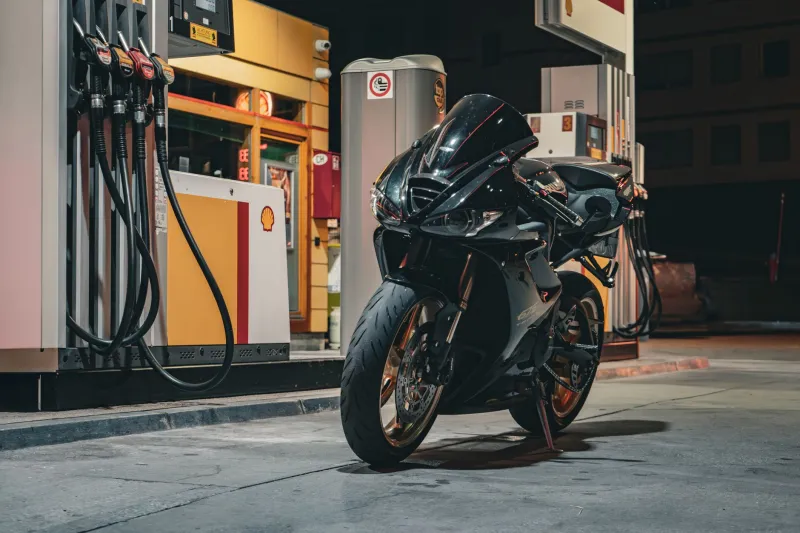
Every big tourer has two fuel gauges: the one on the dash and the one in your head. The dash is optimistic. The head is usually worse. On a 300kg bike with a pillion, luggage and a headwind, the gap between what the handbook promises and what the pump actually delivers can be wide enough to park a van in. The answer isn't a spreadsheet. It's a routine.
The tank is not the problem — the guessing is
A typical heavy tourer might carry 20 to 22 litres. Ride it solo at a steady 60mph on a dry A-road and you might see something close to 50mpg. Add a pillion, fill the panniers, fit a tall screen, load a top box and point it at a wet motorway with a crosswind, and that figure can fall into the high thirties without anything being wrong with the bike. The tank hasn't shrunk. Your margin has.
The danger isn't running dry on a busy dual carriageway. It's the slow creep of bad habits: skipping a stop because you're making good time, trusting the gauge because it hasn't moved yet, then spending twenty miles at 45mph behind a lorry because the reserve light is on and the next services are 'somewhere near'. That's not adventure. That's poor planning with a soundtrack of anxious silence.
What actually moves the numbers
Load is the obvious one. A pillion plus full luggage can add 150kg or more to a bike that already weighs the best part of a quarter-tonne. That's a lot of extra mass to accelerate, and every overtake costs fuel. But weather matters just as much. Cold air is denser, wet roads increase rolling resistance, and a headwind is simply a tax on progress. A bike that returns 48mpg on a mild, dry day can drop to 40mpg in grim November conditions without the rider doing anything different.
Then there's E10. Since it became the standard petrol in the UK, plenty of riders have noticed a small drop in economy — usually a few per cent, because ethanol carries less energy than pure petrol. It's rarely a reason to panic, but it is a reason to stop treating your old fuel figures as gospel. If your bike is E10-compatible, use it and adjust your expectations. If it isn't, pay the premium for E5 and factor that into the cost of the trip. Neither choice is wrong; ignorance of the difference is.
Build a rhythm, not a calculation
The most useful fuelling tool on a big tourer isn't the gauge. It's the trip meter. Reset it at every fill-up and learn your real-world range for the riding you're actually doing. Solo commuting might give you 190 miles before reserve. Two-up touring in Scotland might give you 150. Those are different numbers, and they deserve different routines.
A sensible habit is to start looking for fuel at half a tank on any route where pumps are sparse. In the Highlands, mid-Wales, the Pennines or the quieter parts of the South West, that's not overcautious — it's basic self-preservation. On motorways and busy A-roads, you can push closer to a quarter tank, but only if you know where you're stopping next. The reserve light is not a planning tool. It's a warning that your planning has already failed.
The psychology of the reserve light
Reserve lights on big bikes tend to come on with roughly 30 to 40 miles of range left, depending on the model. That sounds generous until you remember that the last few miles are often ridden at reduced speed, in the dark, with a pillion asking whether you're sure about the next exit. The light also tends to appear at the worst possible moment: just after you've passed a services, or halfway up a long climb where the nearest station is a single pump in a village that closed at five.
Treat the light as a deadline, not a suggestion. If it comes on and you're more than ten miles from a known forecourt, slow down, smooth your inputs and take the next sensible stop. Don't gamble on a favourite garage that might have closed, changed hands or run out of unleaded. Britain's pump network is good, but it's not uniform, and a quarter-tonne bike is not fun to push.
Long days, remote routes and the two-stop rule
For a long touring day, the simplest routine is a two-stop rule: fill up, ride for roughly half your comfortable range, then fill again even if you don't strictly need to. On a 200-mile day, that might mean stopping at 90 and 180 miles. On a 300-mile day, it means three stops. Yes, it adds time. It also removes the low-level hum of fuel anxiety that makes riders skip lunch, rush junctions and make poor decisions late in the day.
On remote routes, apply the same logic but with a bigger buffer. If the next reliable pump is 60 miles away, don't arrive there on fumes. Arrive there with a third of a tank and the option to change plans. Weather, road closures and unexpected detours are all easier to handle when you're not also managing a fuel crisis.
Keep it boring, keep it working
The best fuelling routine is the one you don't have to think about. Reset the trip. Note the half-tank point. Use the reserve light as a hard stop, not a challenge. Accept that E10, a pillion and a wet headwind will change your numbers, and build in the margin rather than arguing with it. A quarter-tonne tourer is a brilliant machine for covering distance, but it rewards riders who plan like adults and ride like they've got somewhere to be. Range anxiety is optional. A little discipline is not.